
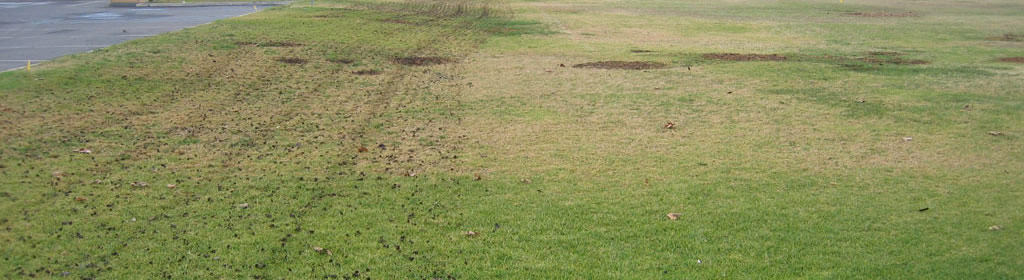
Oftentimes, a decline in the health of your lawn is blamed on factors that have nothing to do with the cause. Typically, the main issue can be soil compaction and In order for your landscape to remain healthy, you may need the services of Plant Rx (a division of Kastle Kare) to aerate your lawn.
What Is Aeration & How Does It Help My Lawn?
The problem starts when the top 4 inches of the soil become compressed, impeding the movement of air, water and nutrients to the grassroots. This stresses the grass plants, making them less able to compete with weeds and slow to recuperate from injury.
Compacted soil contributes to the accumulation of thatch because restricted oxygen levels in highly compacted soils impair the activity of earthworms and other thatch-decomposing organisms. Left unmanaged, thatch can lead to serious maintenance and pest problems. Thatch accumulates faster on compacted soils and heavy clay soils than on arid soils. Therefore, some lawns may require frequent aeration treatments to aid in thatch control.
While removing cores of soil, the spoons or tines also sever roots, rhizomes and stolons. Grass plants are stimulated to produce new shoots and roots that fill up the holes in the lawn and increase the density of the turf.
If soil is compacted, the solution is straightforward: aerify. The practice of physically removing cores of soil and leaving holes or cavities in the lawn is defined as core aeration or aerification.
Benefits of Core Aeration
- Loosens compacted soil and increases the availability of water and nutrients
- Enhances oxygen levels in the soil, stimulating root growth
- Increases the activity of thatch-decomposing organisms
- Encourages new root growth
- Reduces water runoff
- Increases lawn drought tolerance
- Improves lawn overall health